Want to know what it's like at a trade show? In this video I walk the floor at The National NeedleArts Association trade show and talk to a few vendors.
I follow my enthusiasm by reading…a lot. And once a month, I share (some of) the books I read last month and the books I intend to read this month. You can join the informal book club by sharing your own list with me on Facebook and find all the posts here.
Pathways to Possibility, by Rosamund Zander (I also reread her first book this month) – If you feel stuck and without options, Zander's books are an excellent reminder that there's always possibility, it's just a matter of reframing.
Invisible Man, by Ralph Ellison – This book has been on my Great Books list forever, and after watching Luke Cage read it, I got it from the library. Soooo good. And if you liked Luke Cage, you should totally read this book.
The Trespasser, by Tana French – If you've been reading these posts for long, you know I fell in love with French's writing last summer. So as soon as this book came out, I picked it up from my local bookstore.
Sometimes the right collaboration can make a BIG difference in your business. That's exactly what happened with Starship Captain Jill Maldonado (of Material Rebellion) and her friend, Linda Ruel Flynn (of Flora-Ly). They met almost by chance and have built their relationship into a partnership based on mutual respect and equal levels of enthusiasm. Read on to hear their story.
Tell me a bit about what each of you do:
Linda: I preserve flowers and create custom botanical collages that will forever connect you to a time, event, person or place that otherwise would feel lost in the past.
Jill: I design instruments of the imagination for creative kids using reclaimed textiles. (That means I make toys and accessories for children that encourage open ended play and I make them all from discarded jeans and t-shirts.)
How did you start working together?
We both belonged to an artisan group here in Western MASS and really connected at a holiday party over our frustration about feeling stuck in our businesses.
Jill: I felt like I’d been trying to have this conversation over and over again with every maker I met. When I talked with Linda, I finally felt like someone was speaking my language.
Linda: Connecting with Jill created a spark. She was the embodiment of what I felt I had been missing in my business, the kindred spirit who can have long, deep conversations over the minutia we all ponder. Aside from the fact that she is funny, bright and knowledgeable I had a deep appreciation for her work and level of craftsmanship. We had a great conversation at the party, emails went back and forth and I made the leap to send an email that said, ‘what if we work together for each other’s businesses? here’s what I am thinking…what do you think about that?’
Jill: Even though I didn’t know Linda well, personally, I knew that I respected her work and I felt like we had similar goals for our businesses. I was thrilled at the idea of meeting and talking with her more about what we were each trying to do.
HOW do you work together? Where do you meet? What do you discuss?
Jill: Because we didn’t know each other well at the time, we started with a fairly formal structure. We met once a month in a café that was a midpoint between our homes. (We actually live two hours away from each other!) We’d be very careful to dedicate an equal amount of time to each other’s business. We discuss anything and everything! Sometimes we’re looking at broad strategies- branding, targeted customers, what space we occupy in the market. Sometimes we’re super-focused on tactics – this photo, that font, this copy, those print materials. It’s very flexible and bends to each of our needs in the moment.
Linda: We joke that the barista our third partner in business! We start with breakfast and end with lunch. We found the perfect cafe where they don’t give the evil eye for sitting for up to 4 hours at at time. I really appreciate our HOW. We have come to a very fluid place of give and take. Not only the day of discussions but the follow-up that happens. We don’t let topics drop just because we aren’t sitting across from each other.
Do you have a schedule or a plan ahead of time, like the specific questions I ask in the Starship weekly chat?
A few days before we’re going to meet, we’ll email each other with a general idea of what we each want to talk about, along with any pictures, links to articles, podcasts or videos that will help the other prepare for the discussion. By preparing ahead of time, it makes us better able to use our time together effectively. We also give ourselves as much time as possible for our meetings. By setting aside several hours, we’re able to dive very deeply into each other’s work. This means, if one of us is struggling with writing website copy or forging a new brand identity, we can do actual work together with long silences while we both focus on the problem. Or, we can go through several iterations of an idea in one sitting, getting up to stretch or (of course) get more coffee.
Now, nearly two years later, our working relationship has become more intuitive and less formal. We reach out to each other a lot through text, email and phone with little questions or worries that we’re looking for support on. We get together at LEAST once a month, sometimes more. Sometimes these are long, working meetings and sometimes they’re just quick catch ups. We’ve added a new element of putting our strengths and skills to work for each other on bigger projects.
Jill: For instance, when I wanted to take my website to the next level and Linda decided I needed photos of kids using my products, she not only found me a model, but she created beautiful black and white paintings to use as set pieces. We worked out the concept together, but she was able to execute it in a way I never could have. (You can see the paintings from the shoot here.) Now, as I’m designing and building my first trade show booth, Linda is again right there with me as we work out the concept and she creates her amazing paintings. They’ve become a big part of my brand identity.
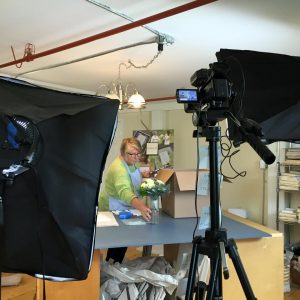
Linda: In tandem with that I am laying the groundwork to push my work out on a broader geographic area. I knew that would involve customers having to ship their wedding flowers to me. I needed a How To Pack Your Flowers video. Jill, with an enthusiastic Yes! and her trusty BFA from NYU film school, came to my studio for a day to shoot video. Not only that, she is editing and will hand me a finished product for my website. This is a huge step for my business that would have happened much further down the road if it had not been for Jill.
One of Linda's paintings in action, working for Jill's brand
Another exciting thing we’ve started doing is a quarterly retreat. We’ll get an inexpensive AirBnB in a central location and take 2-3 days away from family and the daily grind of our businesses to power through some big stuff. With that much time, we can work side by side on our own thing and stop to get opinions, work out issues, work on each other’s things. It’s pretty amazing.
Linda: At about 10pm on our first night away Jill looked over and said, ‘Can I have at your website?’ Absolutely! By 2 am she had cleaned up, re-written some copy, created Book Now buttons and all around made it the lovely website it is today. I appreciate the level of trust we have created.
What lessons have you learned from working together?
Jill: I’ve learned the power of letting someone else help. It can still be hard to ask for help because I feel like I’m taking up Linda’s time or taxing her talents for my own benefit, but I’ve realized that I have a lot to give too. Sometimes we take our own gifts for granted because they’re the things that come easily to us. By working with Linda, I’ve come to a better understanding of what my own strengths are. For absolute sure, by working together we have both moved our businesses further, faster and better than either of us ever could have done alone. We like to say that we move mountains together. I love that idea. Although, I tease Linda that now, through the work we’ve done together, I feel that we don’t need to push against those mountains anymore, but we’re soaring over them instead.
Linda: I have learned I am not an island. As a person without siblings, alone has always come easily to me. I don’t seek the company of others for the heck of it. But working with and becoming friends with Jill has really brought home the power of complimenting resources. We are much stronger together than apart.
Behind the scenes of their collaborative video shoot for Linda's business
What are you most enthusiastic about right now?
Linda: I’m excited for Jill’s trade show!!! She has approached this with such depth that I just can’t wait to see what happens. Her message and commitment to her vision and product inspire me. I’m also excited for the upcoming changes in my business. Casting a wider net has me thinking more about my website, my product offerings and my message. Taking my business to a demographic that is new to me is terrifying but so necessary.
Jill: I’m enthusiastic about watching Linda take a local, 2nd generation business, pivot it to make it undeniably hers and reach out to a national market. I’m enthusiastic about my first trade show too! Actually, it’s the thing I’m most terrified about at the moment! I’m excited to strike out into the wholesale market with a strong brand, a cohesive product line and a beautiful booth that embodies everything I’ve been able to achieve through this co-working, synergistic, accountability partnership. Thanks, Linda!
What should other business owners look for in a potential accountability partner?
Don’t worry about working whether or not your potential partner works in a similar industry or has a similar business. It’s almost better to work with someone in a totally different area. That way there’s absolutely no competition and you each bring a fresh set of eyes that might more easily spot faulty assumptions you’ve been making about how or why you do things in your business. The most important thing is that you both have a similar vision for where you want to take your businesses. For instance, if you want to build a global brand and someone else wants to build a business doing retail craft shows that brings in extra money for groceries, those are both great, legitimate businesses to build, but you might be better able to help each other if you have your eyes on the same horizon. To go back to the analogy we use about moving mountains, it helps if you and your potential partner both want to move the SAME mountain. You also want someone who approaches the relationship with a generosity of spirit that matches yours. You will both benefit from the help you give each other.
Linda: I can’t say enough about the generosity of spirit. There is no score keeping! When two people bring open hearts, skill sets and the sense that WHATEVER is talked about and worked on will benefit you both, you can’t go wrong.
Jill and Linda met outside the Starship, but we've also got an Accountability Partner program on the inside, as well as the option to connect + collaborate with other business owners through the forums, weekly chats, and more. If you think this type of partnership and accountability could benefit YOUR business, you're in luck! The Starship is now open – click here to learn more.
Want to learn more about how you can find and use collaborations and business friends? Join us for the free workshop this week!
Here's a round-up of what I saw, did, and read this month!
The News:
I applied for my passport this month! Squeee! All in preparation for my UK events in November. If you want to take a business class and you're anywhere near Manchester, England, join Joeli and I for our two day-long workshops. (There are limited spots, so register now!)
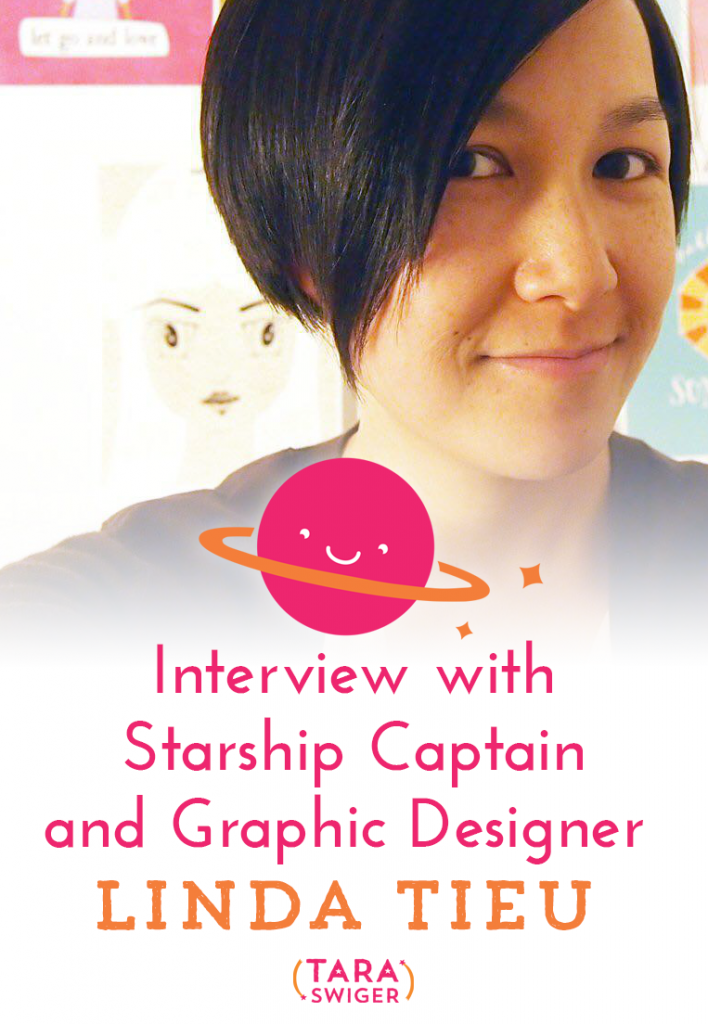
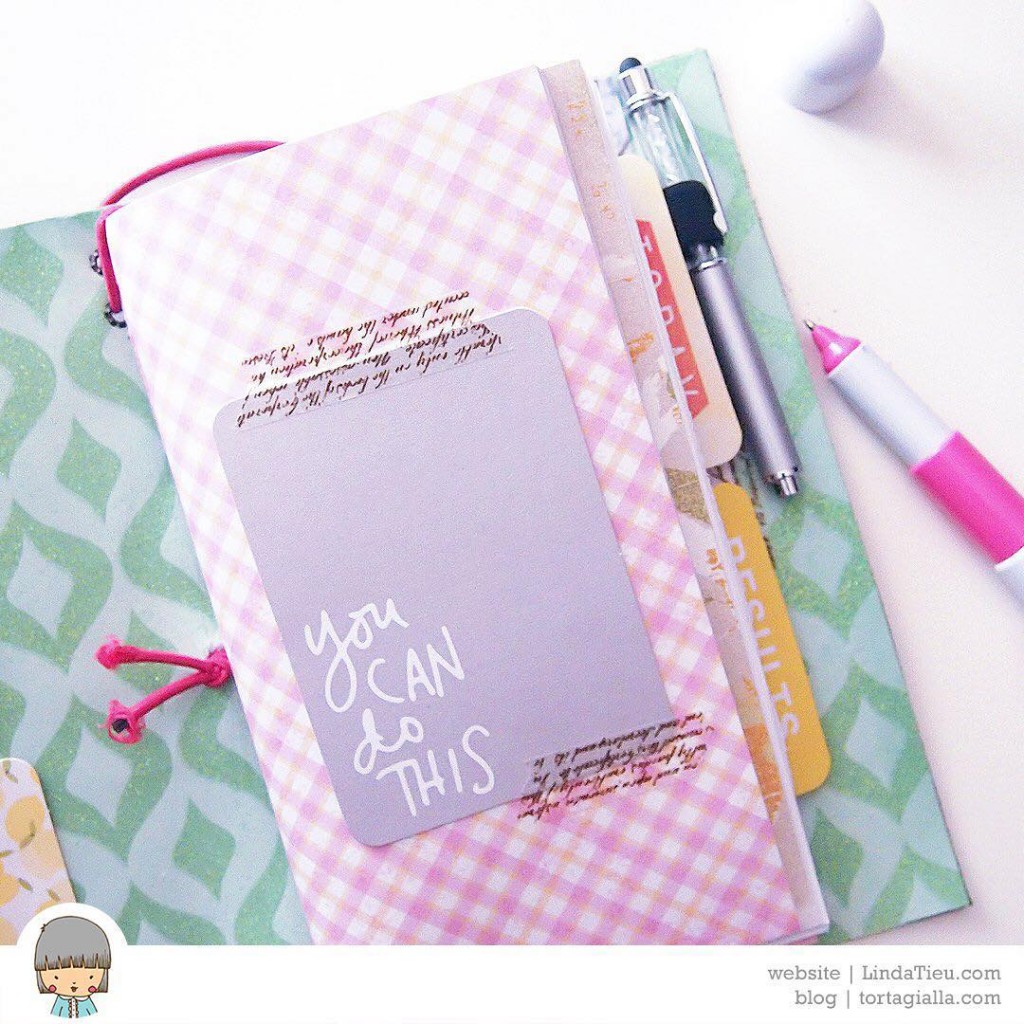
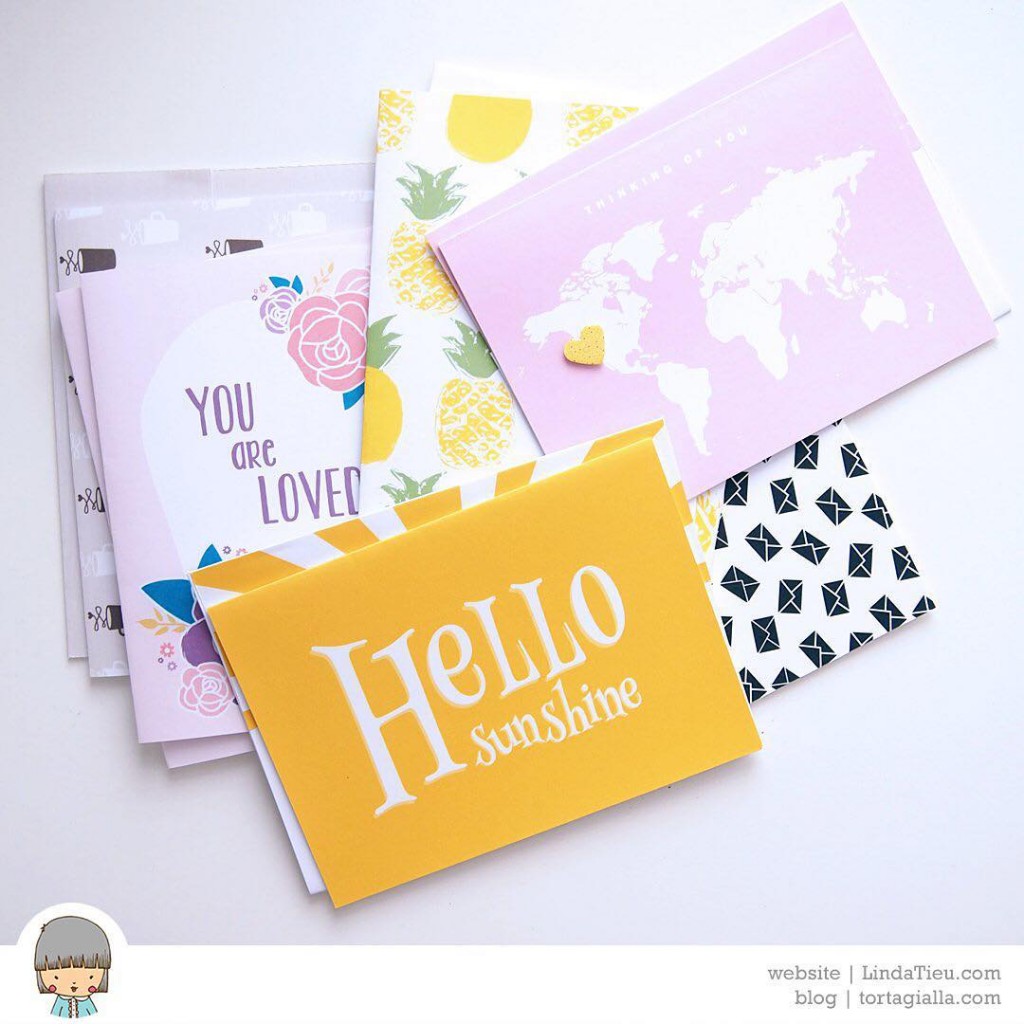
Today I'm happy to be sharing an interview with Starship Captain and graphic designer Linda Tieu. Linda is the creator of HappyPrintClub.com – a library of digital printables for paper lovers, snail mailers and crafters. You can follow her creative adventures on tortagialla.com where she shares printable downloads and fun crafty tutorials.
People have this fantasy of what it's like to be a full-time maker. But what's a normal day for you really like?
A normal day starts with getting my kids up and ready for the morning and getting my toddler to nursery school while my younger baby stays with me. The work day is a lot of back and forth, juggling time between mom duties, household duties and work duties. If you compare to a regular 9-5 job, it's like having a whole of meetings throughout the day, cutting your time into little chunks. I have to prioritize my tasks and try to utilize every small chunk of time I get. Often, I do catch up at the end of the day, late at night. It's not really glamorous at all – it's just real life!
There are so many ways to make a living as a maker – how are you doing it? What have you combined and how has that changed through the years?
I used to work in tech startup environments so it was very fast paced with long hours. Now that I'm on my own, it's still hard work but it's on my own terms for my own ventures. I've taken my experience in business, project management and design and turned it all into a freelance lifestyle that matches up with the season of my life, being a mom of young kids right now. I used to work more hours before I had responsibility of kids. Now, I've had to cut back on my hours and build passive streams of income to make ends meet. Ultimately, it's about creating a lifestyle that I want and having the freedom and control to change with the times.
I'm working on building up HappyPrintClub.com which is a library of digital printables for paper lovers. Members sign up to get access to the entire library of printables that I continually post to every week. Instead of selling each item separately, I'm putting it all together and letting it grow to offer my members the best value. This is one of my projects that brings me income while doing something I love – which is creating printable designs. In my mind, it's a win-win because I get to create continually and members get a HUGE deal. There's nothing more satisfying than seeing my work out there in the world, giving people enjoyment and satisfaction.
What's your definition of success in your business?
I used to think success meant an income number or certain recognition, but over the years I've realized that success is actually how I feel at the end of the day. What's most important to me is feeling fulfilled, productive and good about what I do. If I feel good about what I've done when heading off to bed, it means I'm doing it right and all the other pieces are fitting together properly. Sure, we might all have off days, but the core feeling is what I'm getting at. When you are happy, it means success!
What's the next destination you're working towards?
I'm hoping to build up the membership on HappyPrintClub.com even more and will continue to add more projects to my design portfolio because ultimately, I love creating and sharing my work with others. I have a huge list of ideas, so it's just a matter of taking one step at a time. The next project on deck has to do with sheep – for all my fiber lovers out there!
Want to hear from more Starship Captains like Linda and learn how they balance life + work as creative entrepreneurs? Sign up below to get the inside track on their stories!
How do you actually DO what you want to do in your business?
Do you need to understand WHY you're doing it?
Do you need to be held accountable?
Or do you rebel against anyone telling you to do anything (even when you really want to do it)?
This question fascinates me, because it's at the heart of why some people build their business quickly and others struggle along without ever taking much action.
When I talk to makers and artists who are frustrated that their business hasn't grown, it's very rare that they have NO idea what they should do. Instead, it's that they aren't taking the actions they feel they need to take, they aren't doing what they want to do.
The best explanation I've ever found for WHY some people struggle to get stuff done, is in Gretchen Rubin's book Better Than Before(it's all about habit change, and working on your business really is about habits). She defines the Four Tendencies, as a reason for why some people get stuff done (or change their habits, or work on their biz) and others don't.
I've talked about this more on the podcast (listen in here), but this comes up so often, I wanted to revisit it.
According to Gretchen (and backed up by my own experience working with hundreds of makers and artists), we react to expectations (ie, people telling us to do something), in one of four ways. The way you react to expectations tends to be consistent across your life.
Upholders:
These people do everything that's expected of them, easily. They both meet external expectations (other people telling you what you should do) and internal expectations (things YOU want to do). I have met very few Upholders, and I think it's because they don't seek out biz support – once they know what to do, they just do it.
Questioners:
These people (uh, myself included) don't care to meet external expectations unless they understand WHY. But they have an easy time meeting internal expectations… if those expectations are built on understanding the rationale behind them. In other words, we questioners can do anything if we can turn it from external expectation (you telling me to do something) into an internal expectation (I understand why, and now WANT to do it, because it makes logical sense to me).
These people need to know WHY they are doing anything in their business (“because experts say so” isn't enough). Because I'm a Questioner, I create all of my classes and books for Questioners – I don't tell you what to do, I tell you why something will benefit your biz, then I give you a bunch of questions related to your business, so you can see how to do it in your OWN way. This is why I've built the Starship experience to start with you getting clear on your goals and your path – so that you decide what you want to learn and what you want to do next, and feel motivated to do the work because you can see how it fits into the bigger picture.(According my unscientific study, about 1/3 of the Starship members are Questioners)
Obligers:
These people (maybe you?) have a pretty easy time fulfilling external expectations (if someone asks you to do something, you will), but have a tough time fulfilling internal expectations (say, working on your business, just because you want to). In fact you may fill your days doing things others care about more. So you feel frustrated that you never seem to make the time to work on what matters to YOU. Ugh, this is frustrating.
The solution? Get someone to ask you about what you really care about.
In other words, externalize those internal expectations.
You can do this with a group (like the Starship), where you tell us your goal and then check in as you work through it (this is why we have the weekly live check-in and forums) or with a single person (an accountability partner). After learning that about 2/3 of the Starship members were Obligers, I upped our accountability-providing, by creating the Accountability Partner Program – you just fill out a short form, and I match you with a partner. The two of you work together to decide when to check-in and then you simply tell the person: This is what I'm working on, I'm going to be done with it by X date. That, alone, can suddenly make you feel like you “owe” someone and so you work harder on your business!
Rebels:
These people tend to feel constrained by any kind of expectation. They tell me (we have a handful in the Starship) that “As soon as I write something down, like a goal or to do list, I suddenly do NOT want to do it.” In fact, creating a schedule or a must-do list is going to ensure that a Rebel never does anything.
The solution? I'll be honest, I have been thinking about this for over a year and quizzing any rebels I meet. Gretchen doesn't offer any solution in her book, and I had a hard time coming up with one. Joeli is a self-described Rebel who has made MASSIVE momentum in the last year of her Starship membership (you can get her full story if you sign up here) and she says what works best is making a big list and then picking, each day, what feels fun (instead of telling yourself you HAVE to do something that day), and setting goals that are more about paying attention and learning, than about measuring. (For example, set a goal of “noticing what already works in my business.”) In other words, for Rebels, taking the pressure OFF is often a good motivator for working harder (but if you already feel bad about how little you get done, this might feel REALLY scary). This is why we focus, in the Starship, on finding what works for YOU and giving yourself permission to not do what other people tell you “have” to do.
I hope you see that the answer lies not in forcing yourself to work in ONE way, but in finding what works best for you. No one of the above is better than the others (although I think we all secretly wish we could be Upholders!) – the key to productivity is acknowledging your tendency and then setting up your work day and expectations in a way that works for you.
If you think that more accountability, question-answering and a community of encouragers would help you in your business, check out the Starship – it's open now! The Starship opens only a few times a year and will close again on 3/25, so head here now to learn more about it!
A few weeks ago, when I taught at Midwest Craft Con, I spent the day in handmade clothes and accessories. From the beautiful dress Karen + Kelly, of Gentle Clothing made me, to the viola-wood necklace given to me by the Hang Ups in KC. As you might guess, I felt absolutely amazing all day. Beautiful. Loved.
And that's WHY we make, isn't it? Of course we make stuff because it feels good, but that expands when we give it away, when we sell it, when we allow someone else express themselves through our art.
We make more dresses, necklaces, yarn, patterns, paintings, sculptures that we will ever need. We, as artists and makers in business, make more because we want our work to go OUT to be in the world, to adorn someone's body or walls and to become someone else's expression, someone else's joy. We want to know our work is bringing color into more lives.
The necklace, the dress, the art in my house – it has become a part of my life, a part of what I'm doing in the world.
So when you feel shy about marketing (ie, telling other people about the awesomeness of your work), remember this. Remember that it's not about selling YOUR thing, it's about giving your buyers the opportunity to be part of what you're doing, to take what you're doing and make it part of THEIR lives.
Not every maker and artist chooses to sell their work (or make more than they want for their own home). But you do. You want to not just make your art, but share it with others. You want someone to take your work and build their own meaning, their own message with it.
In order to do this, you need to continue to work on your business, to grow your own skills, to refine your message, and to do the work of building the business you want.
If you'd like support, encouragement and accountability during this journey, The Starship may be the community you need. It only opens once a quarter and it's opening again TODAY. If you're not sure if it's for you, or you'd like to ask questions about it (or just chat with me more), you are cordially invited to a Q+A today, March 15th.
Sign up here to learn more, get access to the Q+A (and the recording!) and meet a few of the Captains who already aboard.
(No idea what I’m talking about? Read more about the Starship here.)
If The Starship isn't for you right now – that's totally fine! Stick around and I'll keep posting weekly lessons to help you build your creative business.
This weekend I'm teaching about marketing, so I've been thinking about a lot (even more than usual, and I wrote a whole book on it…so it's a LOT).
As I say in my book: Marketing is simply communication with a purpose – the purpose is to help people who will love your thing understand that they will, in fact, love your thing.
But speaking with that purpose, sharing with that with that purpose, can make us feel awkward and stilted. So we either skip it all together (and no one knows we sell anything! And no one buys it!) or we get weird and sound like a robot.
This week on the podcast, we dove deep into how to fix this, how to sound (and feel!) like a real person online. It's not easy. I know. It's easy to feel like you have to be formal, or fancy (“professional”), or that you're NOT being genuine if you're also trying to sell something.
But I've overcome this struggle myself and worked with hundreds of makers and artists as they've overcome it. It just takes practice (lots of practice) and intention (paying attention to what you're doing and why).
If this is something you struggle with, you can listen in to the full episode (and learn the 4 steps to sounding more like a person) or you can watch my live recording here. You can also find it on iTunes, Stitcher, or just search for “Explore Your Enthusiasm” in whatever app you use for podcasts!
How about you? Do you struggle to sound like yourself online? Or do you feel good about it?